Brooding Management in Poultry is done in the first 14 days period of the broiler poultry life – which is the most sensitive period because the bird is changing from an immature system to a mature system. For a better and profitable poultry production we can’t ignore Good Brooding Management practice.
While Brooding Management in Poultry, poultry producer’s one common mistake is to think only of maintaining the proper temperature. Apart from temperature we should also take care of other issues. Other issues like 80-20 rule , which means that 80% of the consequences come from 20% of the causes. While brooding we should always think about the brooding temperature, air quality, water and feed. Proper management of these areas will be the key factor to uniformity, which results in good performance. We will assume that we receive good quality chicks from the hatchery, which means that the day-old chicks are active with bright eyes wide open, with strong and shiny shins, navels healed, without physical defects, no pathogens and with good maternal immunity.
The first week of Brooding Management in Poultry corresponds to 23% of the life of the 1.75g broiler. This first week represented 11% of the entire life in 1978 to achieve the same weight. So the proper commitment to a good start is very important for the broiler, and each good point achieved will be rewarded in good performance. In many countries, some poultry producers think that by the second week the birds are adults already and stop giving them external help to maintain good conditions. This could lead to one of the worst situations in the brooding period.
Temperature of Brooding Management in Poultry:
Two basic systems of temperature control are used for brooding management in poultry:
- Spot brooding (canopy or radiant heaters). The heat source is local so chicks can move away to cooler areas and thus select for themselves a preferred temperature.
- Whole-house brooding. The heat source is larger and more widely spread so chicks are less able to move to select a preferred temperature.
- Whole-house brooding refers to situations where the whole house or a defined part of the house is heated by ‘forced air heaters’ only and the aim is to achieve one temperature in the house or air space.
In both spot and whole-house brooding systems, the objective is to stimulate both appetite and activity as early as possible. Achieving the optimum temperature is critical. Brooding temperatures for RH 60–70%
Spot Brooding :
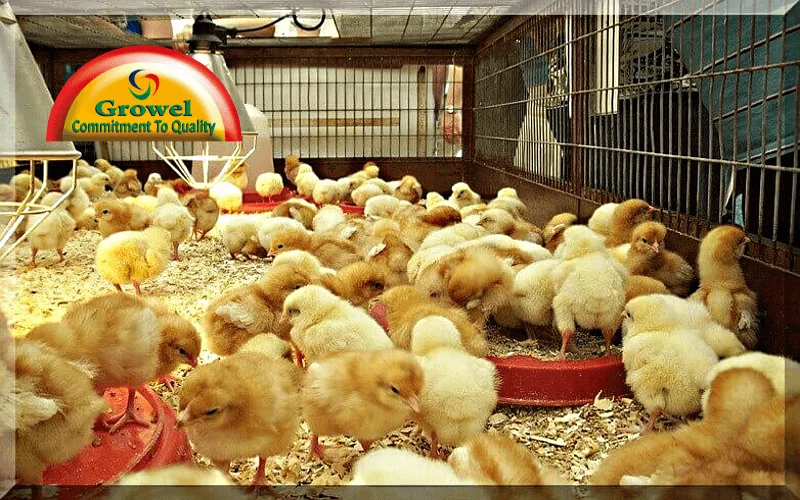
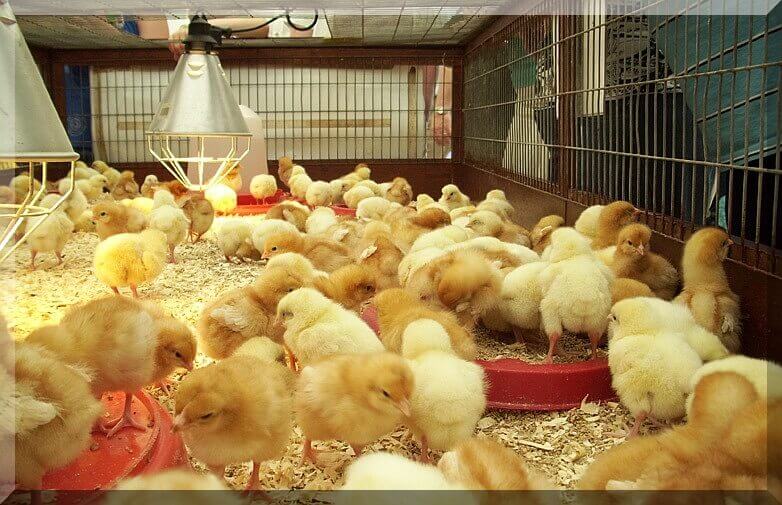
Chick behavior is the best indicator of correct brooder temperature.With spot brooding, correct temperature is indicated by chicks being evenly spread throughout the brooding area.
The layout for a spot brooding set up would be typical for 1,000 chicks on day one. Chicks are placed in a 5×5 meter square (25 m2) or a 16.5×16.5 foot square (272 ft2), which gives an initial stocking density of 40 chicks/m2 (4 chicks/ft2) If stocking density is increased, the number of feeders and drinkers, and the heating capacity of the brooder, should also be increased accordingly.
Whole-House Brooding:
In whole-house brooding, there is no temperature gradient within the house, although supplementary brooders might also be provided. The main whole-house heat source can be direct or indirect (using hot air). Carefully monitor and control house temperature and humidity when whole-house brooding is practiced.
Chick behavior is the best indicator of correct temperature. With whole-house brooding, correct temperature is indicated by chicks forming groups of 20–30, with movement occurring between groups. There should be continuous feeding and drinking within the flock.
Key Points To Remember About Brooding Temperature of Brooding Management in Poultry :
- Temperature is critical and should be maintained as recommended.
- Temperatures should be checked manually at chick level.
- Chick behavior should be observed closely and frequently.
Litter temperature is the most important because day-old chicks are extremely dependent on floor contact to help regulate the changing temperatures. The ratio of body surface to body mass is large in the day-old chick and it decreases with age, so the young chick will lose heat faster than an adult bird.
The young chick’s body is covered in down which has a poor insulating value, so if temperature is not controlled it will lose heat rapidly through radiation and conduction. We suggest having the litter preheated and stabilised 24 hours before placement and sometimes preheating of 48 hours , depending on the season, region and outside temperature.
A comfortable chick will breathe through its nostrils and lose 1-2g of moisture in the first 24 hours. The yolk contains this amount of moisture – they will lose weight but not become dehydrated.
If the birds are exposed to cold temperature, they will try to save or make heat by huddling or by burning feed to keep warm, which affects feed conversion ratio and this is the most expensive way.If the ambient temperature is 26ºC (78.8ºF), the same moisture loss (1-2g) in the yolk will last the chick three days. This is why, in practical terms, when we see large yolks we can say that the bird was cooled in the first few days. In the opposite case, with temperature too high, the birds will try to remove heat or avoid producing heat, pant to lose
Always watch & use bird behaviour and effective temperature as the ultimate guide to determine the correct temperature for the birds. Chicks from smaller eggs (younger breeder flocks) require higher brooding temperatures because they produce less heat (about 1ºC) for the first seven days. According to the seasonal climate it is very important to have a tool to heat and cool the air, and options to provide correct air flow and distribution. Do not forget that the broilers in a brooding phase do not need air velocity more than 0.3m/s at floor level.
Air Quality of Brooding Management in Poultry:
Ventilation distributes heat throughout the house and maintains good air quality in the brooding area. An ideal air quality should be with oxygen 19.5%, carbon dioxide less than 3000 ppm, carbon monoxide and ammonia (NH3) less than 10 ppm and dust levels less than 3.4mg/m³.
There are different levels of oxygen availability at different heights (above sea level), with the highest farm having the lowest availability.
The highest levels of carbon monoxide are caused by the incomplete burning of fossil fuels, but the major problem is a combination of concentration and exposure time. Birds can tolerate levels of 600 ppm for 30 minutes, but 3000 ppm is lethal in two hours. The normal air carbon dioxide concentration is 400 ppm. In winter when we see chicks sitting near the outside wall, we think first of high temperature, but the problem can be carbon dioxide. This is because the level of carbon dioxide is too high inside this house, mainly because of the low air rate exchange rate.
The pressure in the house is too low, and with leaks and cooler air falling near the sidewall, the chicks will migrate to where more oxygen is available near these leaks. However, the litter is cold there, with draughts on the chicks and no feed/water present.
High ammonia levels in the house are detrimental for the birds. This is a colourless gas, soluble in water, with a pronounced odour and toxic to the animal’s cells. Water is needed to transform broiler faeces to ammonia, so it is important to reduce the RH levels in the litter to reduce ammonia emissions.
Inadequate minimum ventilation and the resulting poor air quality can cause increased levels of NH3, CO2, and moisture levels and an increase in production related syndromes such as ascites. It is important to always evaluate NH3 levels at bird height. The negative effects of NH3 include foot pad burns, eye burns, breast blisters/skin irritations, decreased weights, poor uniformity, disease susceptibility and blindness.
Water and Feed Management of Brooding Management in Poultry:
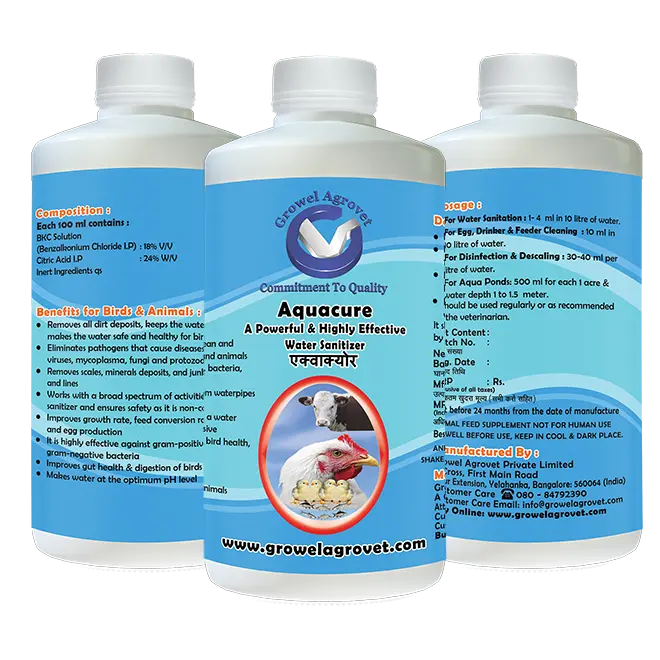
We can call water an ‘invisible’ player in brooding – it can be both enemy and friend too! Many times we see this component forgotten by the broiler industry and poultry farmers. Water is an essential nutrient that impacts virtually all physiological functions. We must give 24 ml of water per bird in the first 24 hours, mixed with Aquacure.
Poultry farmers also shouldn’t forget the importance of cleaning and disinfecting the water lines. The use of 40-50 micron water filters is always suggested to maintain good water quality. The oxi-reduction potential (ORP) of 650- 750mv is a good goal; more than this can result in equipment corrosion, less than this will not disinfect the water properly. The flushing procedure is also a good tool to maintain proper water temperature for the birds.
We suggest using paper in 50% of the brooding area and the amount of feed should be 50g/bird in the period that the paper is in good condition. Use newspaper to ensure adequate time for feeding before the paper breaks down. It should be good enough to last five days.Correct stimulation of activity during the first 5-7 days of age is necessary for optimal feed consumption, digestive and immune system development.
It is recommended that a light intensity of 25 lux in the darkest part of the house, measured at chick height, be used during brooding to encourage early weight gains. Optimum light intensity at floor level should not vary by more than 20%. Another good tool is having a 100 Watt bulb hung over demand pans at the end of the line. At seven days (standard weight) we need to start regulating darkness. The amount of dark hours will vary according to the market specifications for weight.
The best way to improve flock performance is not by increasing seven day weight of the faster starting chicks, but by decreasing the number of slower starters! A good coefficient of variation is 8-10%. A good tool to do is the Chick Check evaluation! It consists of having 100 birds evaluated by looking at the crop consistency.
The crop is palpated after six hours and again at 24 hours post-placement . A good goal is getting 95% of birds with water and feed in the crop. We should not forget that birds are the best sensor in a house.
For better weight gain, lowest mortality, immunity building in birds and diseases protection ,it is highly recommended to use the best quality Poultry Medicines ,which is time tested. To know more about the layer poultry & broiler poultry medication please read and follow Layer Poultry Medicine Chart & Broiler Poultry Medicine Chart .
Summary of Brooding Management in Poultry.
Good brooding management will always result in better flock uniformity. Uniformity is the key to good and consistent results and cannot be achieved after doing a bad brooding job in the first 14 days. The critical factors are temperature, air quality, water,medicines and feed. When these are correct, 80% of your success will be achieved.You should also read Prevention of Poultry Diseases
If you are into poultry related business & want to earn maximum profit in your business then please join our Facebook group How To Do Profitable Poultry & Cattle Farming ?
ग्रोविट पॉवर
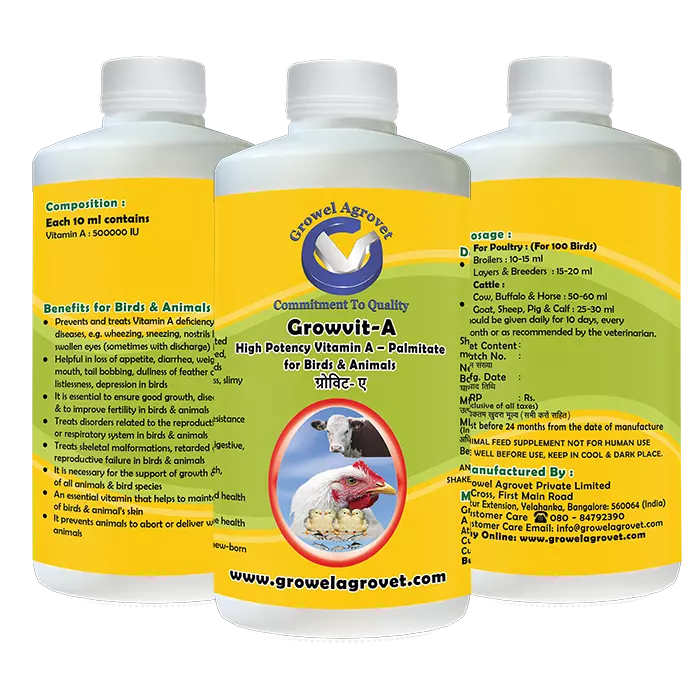
Composition: Each 5 ml contains Vitamin A : 250000 IU Vitamin D 3 : 30000 IU Vitamin E : 150000 Vitamin C : 500 mg Vitamin B 12 : 100 mcg Selenium : 50 ppm Biotin : 25 mcg Lysine : 7.5 mg Choline Chloride : 50 mcg Methionine : 50 mg Indication & Benefits :
Dosage : For 100 Birds : Broilers & Growers : 10-15 ml. Layers : 15-20 ml. For Cattle Cows & Buffalo: 40-50 ml daily. Calf,Goat ,Sheep & Pig : 20-30 ml daily. Should be given daily for 7 to 10 days, every month or as recommended by veterinarian. Packaging: 100 m.l., 500 m.l. ,1 ltr. ,5 ltr.
|
एक्वाक्योर  A Powerful & Highly Effective Water Sanitizer & Disinfectant for Poultry Composition: BKC Solution (Benzalkonium Chloride I.P) :18% V/V Citric Acid I.P :24% W/V . Inert Ingredients qs Indication & Benefits :
Dosage : For Water Sanitation & Acidifier: 5-7 ml in 20 liter of water. For Disinfection & Descaling : 10-20 ml. per liter of water .Should be used regularly. Packaging : 500 ml.,1 ltr. & 5 ltr.
|